
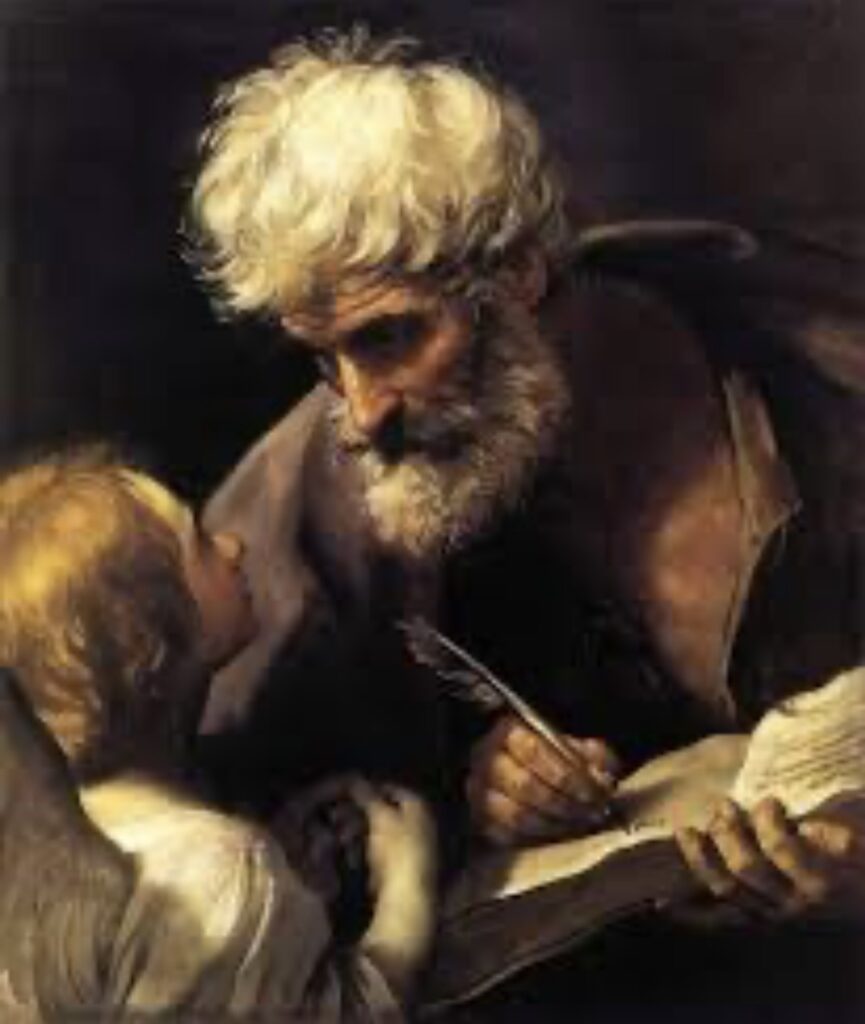
Art moves us because it is informed by worlds we come from, evoking deep memories and feelings that, for each of us, we are consciously or unconsciously aware of at the level of our essence.
A painting by Guido Reni, 1635, depicts an angel speaking softly to Saint Matthew, imparting what appears to be vital information as he scribes the angel’s words into an archive. In the early 1500s, Michelangelo painted the Sistine Chapel, with God’s outstretched finger almost touching Adam’s, suggesting a being from another world making contact with a human being. Leonardo da Vinci focused on anatomical realism, creating earthly-looking wings attached to otherworldly beings with human features. Renaissance painters were at the cutting edge of a new awareness, executing artworks that depicted human connection to otherworldly realms.
Transcendental beings first appeared as wingless figures in early Christian art in the 3rd century, but the iconic winged angel emerged in the 4th to 5th centuries. These depictions often portray angels overseeing human endeavors with love and compassion. They have been described as powerful, intelligent beings of light or spirit, capable of appearing in visible forms. Primarily found in the Abrahamic faiths, Judaism, Christianity, and Islam, angels are believed to serve multiple roles, including offering guidance, protection, and delivering messages.
Mary Beard, The Roman Triumph, Harvard University Press, 2007, explores how mythological narratives about the natural world provide meaning and guide societies through moral and existential questions. Throughout history, artists have drawn on mythologies to create visual representations, connecting generations and societies. Mythology has played a central role in the understanding of art across cultures. In ancient Egypt, Greece, and Rome, art depicted the supernatural realm to convey concepts about the afterlife, in which gods and spirits symbolized societal values, cosmological beliefs, and spiritual teachings.
The extensive collection of mythological imagery tells the story of humanity’s spiritual reflections through history. These artists reveal an unconscious grasp of nonphysical understanding, expressed through their deeper selves. My early encounters with the barbershop painting gave me insight into the larger field, where I discovered sources of intelligence and the origins of the transcendental experiences that shaped my life.
My first glimpses of otherworldly beings occurred at a church on a hilltop near my family’s home. At 11 years old, my friends and I hiked up the hill and entered the chapel, where I encountered paintings and sculptures of God and angels. An eerie sense of recognition overcame me as I was reacquainted with symbols from my long history, awakening a profound awareness. I had experienced overwhelming fears, especially alone in my bed in the dark, when I struggled with night terrors as a child. I focused all of my attention on connecting to protection and peace. After I fell asleep, I was safe. The chapel of God and angels symbolized beneficial nonphysical beings I was unconsciously tuning into since I could remember, and they were real.